Cost guide
What an electrical panel upgrade costs in Illinois
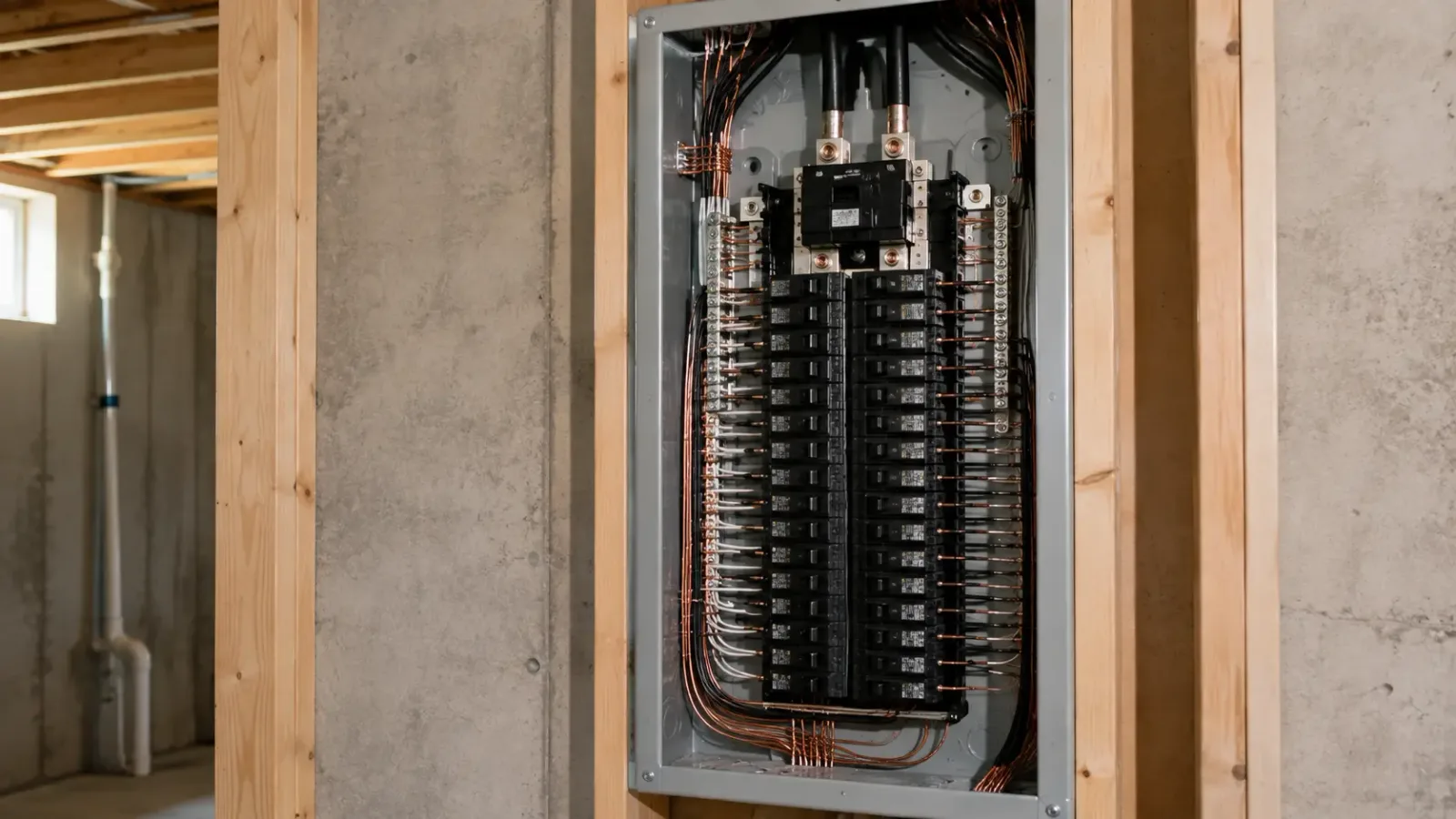
A panel upgrade is one of those jobs where two houses on the same street get quotes that differ by three thousand dollars, and the homeowner receiving the higher one assumes they are being taken advantage of. Usually they are not. The variables that move this number are mostly invisible from the driveway.
The figures below are Chicago-metro numbers. National cost guides consistently under-estimate Illinois pricing, because labour rates here sit above the national median and most of our municipalities require a permit and at least one inspection on service equipment work.
| Scope of work | Typical range | What moves the price |
|---|---|---|
| 100A to 200A, panel stays in placeThe common case. Existing meter location reused, no mast work. | $2,200 – $3,400 | The common case. Existing meter location reused, no mast work. |
| 200A upgrade including new mast, weatherhead and meter socketStandard when the overhead service is original to the house. | $3,200 – $4,800 | Standard when the overhead service is original to the house. |
| Panel relocationFeeder rerouting plus drywall and finish repair. | $4,000 – $7,500 | Feeder rerouting plus drywall and finish repair. |
| Fuse box to breaker panelFrequently uncovers knob-and-tube circuits landing in the box. | $2,400 – $4,200 | Frequently uncovers knob-and-tube circuits landing in the box. |
| Sub-panel for a garage, addition or workshopOften the cheaper answer when you only need more spaces. | $900 – $2,000 | Often the cheaper answer when you only need more spaces. |
| Whole-house surge protection added at the panelRequired on new and replaced services under NEC 230.67. | $300 – $700 | Required on new and replaced services under NEC 230.67. |
Ranges reflect typical Chicago-area pricing and are for planning only — they are not a quote. Actual cost depends on your home, your existing wiring, and the permit requirements in your municipality. Only a licensed electrician who has seen the job can price it.
What actually drives the price
Roughly seventy per cent of the variation between quotes comes down to four things, and none of them are the panel itself. The equipment is a few hundred dollars. Everything else is labour, access, and what the electrician finds once the cover comes off.
- Whether the service mast and weatherhead need replacing — this is the single biggest swing, worth roughly $1,000 to $1,500.
- Whether the panel stays where it is. Moving it means rerouting every branch circuit and repairing finished walls afterwards.
- The state of the grounding electrode system. Older homes frequently have grounding that no longer meets code and has to be redone.
- What the existing branch circuits are made of. Knob-and-tube or deteriorated cloth-insulated conductors landing in the new panel have to be dealt with.
Why 200 amps, and when 100 is genuinely fine
There is a reflex in this trade to recommend 200 amps for everything, and it is often right, but not always. A 1,300 square foot house with gas heat, a gas water heater, gas cooking and no EV genuinely does not need 200 amps. The honest test is a load calculation under NEC Article 220, not a rule of thumb about square footage.
Where 200 amps stops being optional is the moment you add a large continuous load. An EV charger, a heat pump, electric heat, a hot tub, or a kitchen conversion from gas to induction will each push a 100-amp service toward its limit. If any of those are in your five-year plan, upgrading once is cheaper than upgrading twice.
There is also a subtler point that catches people out. A panel can be functionally full long before the service is electrically maxed out, simply because it has run out of physical breaker spaces. That is a different problem with a cheaper solution — a sub-panel rather than a service upgrade.
The permit is not optional, and skipping it costs more
Every municipality in the Chicago suburbs requires a permit and inspection for service equipment replacement, and the utility has to schedule a disconnect and reconnect regardless. A contractor offering to skip the permit to save you a few hundred dollars is offering you a liability, not a discount.
Unpermitted service work surfaces in three predictable places: at resale when the buyer's inspector writes it up, at renewal when an insurer asks, and after a fire when a claim is investigated. The last one is the expensive one.
How to read a panel upgrade quote
Quotes for this work are often a single line and a number, which makes them impossible to compare. Ask for the scope in writing and check that it includes the items below. When one quote is dramatically cheaper than the others, it is almost always missing two or three of them.
- Permit and inspection fees — stated, not assumed
- New meter socket, and mast and weatherhead if the service is overhead
- Grounding electrode system brought to current code
- Whole-house surge protection, now required on replaced services
- AFCI and GFCI breakers where the adopted code edition requires them
- Every branch circuit re-landed, labelled and tested
- Who is responsible for any drywall or finish repair
Electrical Panel Upgrade in your town
Local permit authority, electric utility, and the housing eras that decide what your house actually needs.
All towns for panel upgrades