Kane & DuPage & Will & Kendall County · 180,542 residents
Aurora electricians — licensed, insured, matched to your job
Aurora is the second-largest city in Illinois and contains every housing era in this service area at once, spread across four counties. The near east and near west sides hold substantial pre-1940 stock with the full set of period wiring issues, the mid-century belt carries the usual aluminium and obsolete-panel questions, and the far east and far west subdivisions from the 1990s and 2000s are modern throughout.
- Serving all 6 Aurora ZIP codes
- ComEd
- Permits through City of Aurora
- 18 miles from our partner electrician
KilowattBros is a free matching service. All electrical work is performed by independent, licensed contractors.
Licensed & insured
Work is carried out by licensed, insured electrical contractors — never by us.
Fast hand-off
Your request reaches a contractor the moment you submit it, not a queue.
One contractor
Not a shared lead resold to five companies who all call you at once.
Free, no obligation
Matching costs you nothing. Contractors pay us, and only after you book.
What the housing stock needs
Aurora homes, by the year they were built
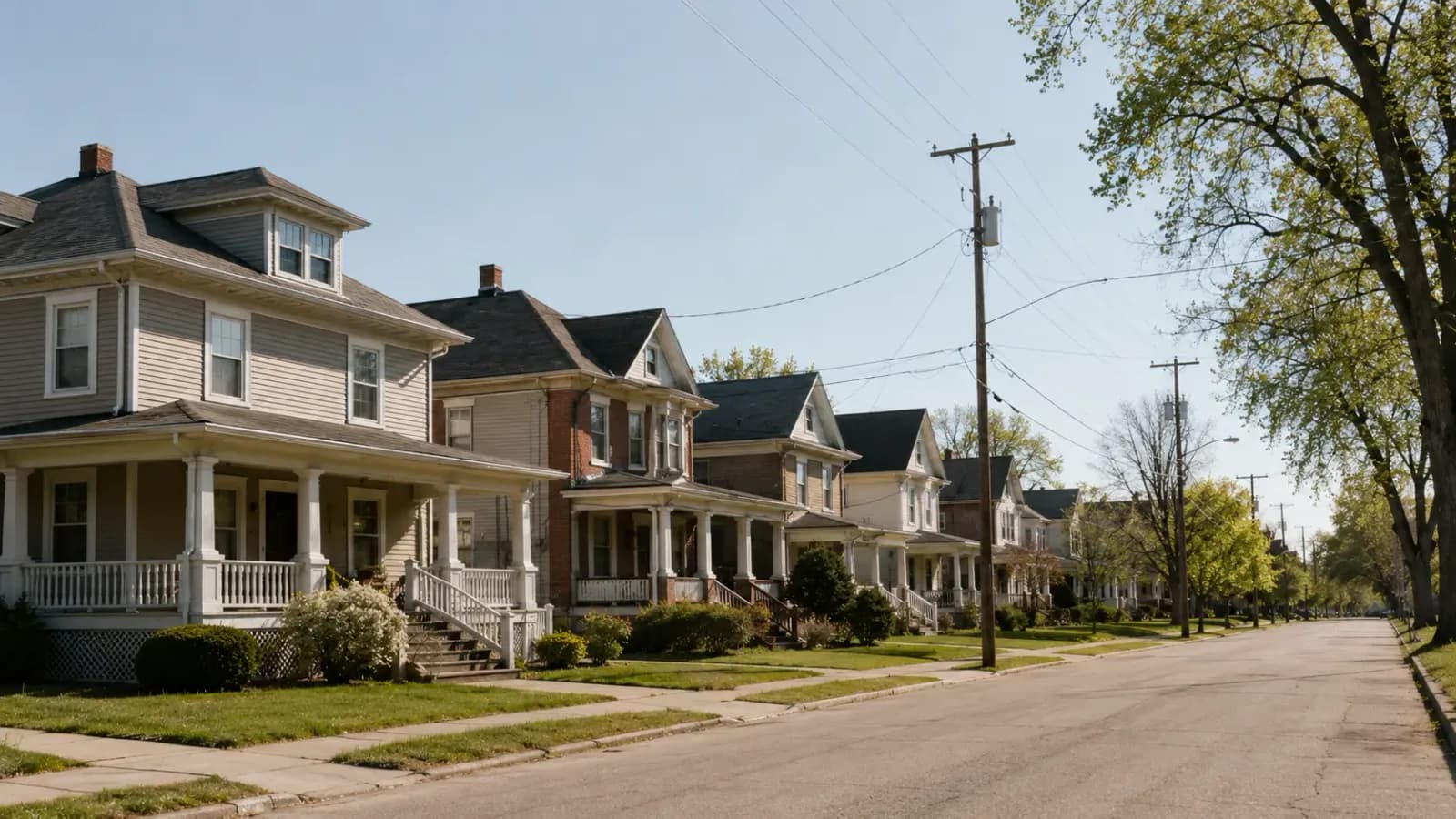
Aurora is the second-largest city in Illinois and contains every housing era in this service area at once, spread across four counties. The near east and near west sides hold substantial pre-1940 stock with the full set of period wiring issues, the mid-century belt carries the usual aluminium and obsolete-panel questions, and the far east and far west subdivisions from the 1990s and 2000s are modern throughout. Nothing about an Aurora address predicts the electrical situation — the neighbourhood does. That is genuinely different from a town like Huntley where one era dominates, and it is why a proper assessment matters more here than almost anywhere else in the metro.
- Historic near east and near west sides1860–1940Most of Aurora
- Large concentrations of pre-war housing with knob-and-tube, cloth-insulated conductors, and 60-amp fuse services.
- Post-war1950–1980
- 100-amp services, obsolete panel brands, aluminium branch wiring in the 1965–1974 range.
- Far east and far west growth1990–2008
- Modern 200-amp subdivision construction in the Fox Valley Villages and west-side developments.
Neighbourhoods and subdivisions we cover
Downtown Aurora, Near East Side historic district, Riddle Highlands, Fox Valley Villages, Stonebridge, Oakhurst — and everywhere else in the 6 Aurora ZIP codes.
Ordered by what Aurora needs most
Electrical work we arrange in Aurora
Aurora is an old-housing town, so the order here starts with the things that fail with age — service equipment, original wiring, grounding — rather than with the things that get advertised.
Electrical Panel Upgrade
Fuse boxes and 60-amp services are still in service here. Replacement is usually the first job on the list, not an upgrade for its own sake — most insurers now ask about it directly.
- Typical
- $2,200 – $4,800
- Permit
- Required
- Duration
- One day for a standard swap; two if the mast and grounding are replaced
Emergency Electrician
Cloth-insulated conductors and original splices fail without much warning, and a house on fuses gives you no breaker to reset when they do.
- Typical
- $150 – $450 for the call-out and diagnosis
- Permit
- Usually not
- Duration
- Most emergency diagnostics resolve within one to three hours on site
Whole House Rewiring
Knob-and-tube assessment is the honest starting point. Some of it is dead and harmless; some is live behind blown-in insulation, which is the version that matters.
- Typical
- $8,000 – $30,000+
- Permit
- Required
- Duration
- One to three weeks depending on size, access, and occupancy
EV Charger Installation
Almost always a service upgrade first. A 60 or 100-amp service has no room for a 40-amp continuous load, whatever the charger's marketing says.
- Typical
- $700 – $2,200 installed
- Permit
- Required
- Duration
- Half a day for a standard attached-garage install
Whole House Generator Installation
Straightforward once the service is modern, and worth pairing with a panel replacement so the transfer switch is installed while the equipment is already open.
- Typical
- $6,500 – $16,000 installed
- Permit
- Required
- Duration
- Two to three days on site, plus lead time for permits and the gas meter
Home Automation & Smart Home Wiring
Frequently blocked by the switch boxes. Pre-1945 switch loops carry no neutral, and shallow boxes often have no room for a smart device even where one exists.
- Typical
- $450 – $6,000 depending on scope
- Permit
- Usually not
- Duration
- A day for device-level work; a week or more for structured wiring
Permits & utility
Who signs off on work in Aurora
Illinois licenses electrical contractors at the municipal level, not the state level. That means the rules, the fees and the inspection queue are Aurora’s — not Kane, DuPage, Will or Kendall County’s, and not Illinois’.
- Permit authority
- City of Aurora — Building & Permits Division
- Electric utility
- ComEd
- Gas utility
- Nicor Gas
- County
- Kane & DuPage & Will & Kendall
- ZIP codes
- 60502, 60503, 60504, 60505, 60506, 60538
- Population
- 180,542
Report a power outage
1-800-334-7661ComEd
Also reachable as 1-800-EDISON-1. You can report by text: send OUT to 26633.
This is the utility, not us — we cannot restore power. If you smell burning or see a downed line, call them first.
- Aurora is the second-largest city in Illinois and spans four counties — Kane, DuPage, Will, and Kendall.
- The city contains every housing era in this service area simultaneously, from 1860s near-east-side homes to 2000s subdivisions, so the neighbourhood predicts the electrical profile far better than the city name does.
- Aurora's historic districts on the near east and near west sides hold substantial pre-1940 housing with original knob-and-tube still present in places.
Local context
What makes Aurora homes different
Aurora is the second-largest city in Illinois and contains every housing era in this service area at once, spread across four counties. The near east and near west sides hold substantial pre-1940 stock with the full set of period wiring issues, the mid-century belt carries the usual aluminium and obsolete-panel questions, and the far east and far west subdivisions from the 1990s and 2000s are modern throughout. Nothing about an Aurora address predicts the electrical situation — the neighbourhood does. That is genuinely different from a town like Huntley where one era dominates, and it is why a proper assessment matters more here than almost anywhere else in the metro.
Aurora housing by era
Historic near east and near west sides
1860–1940Large concentrations of pre-war housing with knob-and-tube, cloth-insulated conductors, and 60-amp fuse services.
Post-war
1950–1980100-amp services, obsolete panel brands, aluminium branch wiring in the 1965–1974 range.
Far east and far west growth
1990–2008Modern 200-amp subdivision construction in the Fox Valley Villages and west-side developments.
Aurora at a glance
- County
- Kane / DuPage / Will / Kendall
- Population
- 180,542
- ZIP codes
- 60502, 60503, 60504, 60505, 60506, 60538
- Electric utility
- ComEd
- Gas utility
- Nicor Gas
- Permits issued by
- City of Aurora — Building & Permits Division
Areas we cover
Downtown Aurora · Near East Side historic district · Riddle Highlands · Fox Valley Villages · Stonebridge · Oakhurst
- Aurora is the second-largest city in Illinois and spans four counties — Kane, DuPage, Will, and Kendall.
- The city contains every housing era in this service area simultaneously, from 1860s near-east-side homes to 2000s subdivisions, so the neighbourhood predicts the electrical profile far better than the city name does.
- Aurora's historic districts on the near east and near west sides hold substantial pre-1940 housing with original knob-and-tube still present in places.
Aurora is not one electrical market
Most towns in this service area have a dominant era. Huntley is essentially all post-1999. Streamwood is mostly post-war. You can say something useful about the typical house and be right most of the time.
Aurora does not work that way, and it is the single most important thing to understand before you get a quote here.
The second-largest city in Illinois, spread across four counties — Kane, DuPage, Will and Kendall — Aurora contains every housing era in this market simultaneously:
- The near east and near west sides, and the streets around downtown, hold substantial pre-1940 stock. Some of it is 1860s and 1870s. Knob-and-tube, cloth-insulated conductors, and 60-amp fuse services are all still present.
- The post-war belt from roughly 1950 to 1980 carries the familiar mid-century pattern: 100-amp services, obsolete panel brands, and aluminium branch wiring in the 1965–1974 range.
- The far east and far west growth areas — Fox Valley Villages, Stonebridge, Oakhurst — are 1990s and 2000s subdivision construction, modern and grounded throughout.
An Aurora address tells you almost nothing. The neighbourhood tells you almost everything.
What that means for you practically
It means you should be sceptical of any quote given over the phone.
In a town with one dominant era, a competent electrician can give you a defensible range before seeing the house. In Aurora that same range is close to meaningless, because the spread between "swap the panel on a 2001 build" and "replace the service on an 1890s near-east-side house with active knob-and-tube" is several thousand dollars of genuinely different work.
It also means the assessment is worth more here than almost anywhere else in this service area. Knowing what you actually have — before anyone quotes on it — is the difference between paying for the job you need and paying for the job that was assumed.
Pre-war Aurora: what the work involves
If your house is in the historic near east or near west side, the pattern is consistent enough to describe.
The service comes first. A 60-amp fuse service is not a panel problem, it is a capacity problem, and nothing else can be sensibly planned around it. Expect the mast, weatherhead and meter socket to need replacing along with the panel — new equipment fed by seventy-year-old hardware is something most electricians will refuse and most inspectors dislike. That is typically $1,000 to $1,500 on top of the panel itself.
Grounding comes second. What satisfied an inspector in 1950 does not satisfy one now. On these houses that usually means driving new ground rods and bonding the water service properly.
Branch circuits come third, and this is where quotes diverge. When the old panel comes off the wall, whatever has been landing in it becomes visible. In an 1890s Aurora house that frequently includes cloth conductors that crumble when moved and knob-and-tube that somebody spliced into during a 1970s remodel. Those specific circuits need dealing with.
That is not the same as needing a whole-house rewire, and this is the point where Aurora homeowners most often get over-sold. Addressing the circuits that land in the panel is a bounded job. Rewiring the house is $8,000 to $30,000 and up. Push back hard on any quote that jumps from the first to the second without showing you why.
Post-war Aurora and the aluminium question
The 1965 to 1974 band is worth calling out separately, because it carries the most over-quoted problem in the trade.
Aluminium branch wiring from that period is not a reason to rewire a house. It is a reason to remediate the connections — the terminations at every switch, outlet and fixture, where the metal expands and contracts and eventually loosens. Done properly with the correct connectors, that runs roughly $2,500 to $8,000 depending on the number of devices.
A full rewire gets quoted for this situation far more often than it is warranted. If somebody has quoted you one, get a second opinion before you get a second price.
The symptoms worth acting on: warm switch plates or outlet covers, lights that flicker on one circuit, a burning smell near a device. Those are connection problems and they are worth attention promptly.
Permits in Aurora
Electrical permits go through the City of Aurora — Building & Permits Division at 77 South Broadway. The four-county spread confuses people, but it does not affect permitting: the city issues the permit regardless of whether your address sits in Kane, DuPage, Will or Kendall.
Aurora is in ComEd territory, unlike several of its Fox Valley neighbours. St. Charles, Geneva, Batavia and Naperville all run their own municipal electric utilities, which catches out contractors working across the valley — a service disconnect in Batavia is scheduled with a different organisation than the same job in Aurora, ten minutes up the river.
Anything that replaces service equipment or adds a circuit needs a permit and an inspection. Repairs to existing devices generally do not. Aurora's historic districts may add design review where work is visible from the street, most commonly a new service mast or a relocated meter on a street-facing elevation — worth confirming placement before equipment is ordered rather than after.
What we do
KilowattBros is a free matching service, not an electrical contractor. We do not perform the work, price it, or supervise it. Your request goes to one licensed, insured electrician who covers Aurora — not to five companies who will all call you. Homeowners pay nothing. The contractor pays us when a request becomes a booked job, which is why sending you someone who cannot do the work would cost us rather than earn us.
Before you get a quote
Costs and comparisons for Aurora homeowners
Ordered by what Aurora housing actually needs. Illinois figures, not national averages.
- Guide
Electrical Panel Upgrade Cost in Illinois
Real Illinois pricing for a 100 to 200 amp panel upgrade, what drives the number up, and how to read a quote. Chicago-area figures, not national averages.
Read it - Comparison
100 vs 200 Amp Panel: Which Do You Actually Need?
The honest answer depends on what you burn gas for. Here is how to work it out before anyone quotes you.
Read it - Guide
Emergency Electrician Cost in Illinois
What an after-hours call-out costs in the Chicago suburbs, which faults genuinely cannot wait until Monday, and what to switch off before anyone arrives.
Read it - Guide
House Rewiring Cost in Illinois
Rewiring cost by house size and access for the Chicago suburbs, when knob-and-tube actually has to go, and why aluminium wiring rarely needs a full rewire.
Read it
FAQ
Electrical work in Aurora — questions
Do I need a permit for electrical work in Aurora?
For anything that replaces service equipment or adds a circuit — a panel replacement, an EV charger, a generator transfer switch — yes, and an inspection with it. Permits in Aurora go through City of Aurora — Building & Permits Division. Straightforward repairs to existing devices generally do not need one. Skipping a permit tends to surface at resale or during an insurance claim, which is the expensive way to find out.
Does ComEd serve Aurora?
Yes. Aurora is in ComEd territory, so a service upgrade that needs the meter pulled is scheduled through ComEd. Worth knowing that four towns nearby — St. Charles, Geneva, Batavia and Naperville — run their own municipal utilities instead, which catches out contractors working across the Fox Valley.
What electrical work do Aurora homes usually need?
Most of Aurora's housing dates from the 1860–1940 period. Large concentrations of pre-war housing with knob-and-tube, cloth-insulated conductors, and 60-amp fuse services. That is the pattern here, though any individual house can differ — the year on the deed predicts the problem better than the size or the price does.
How fast can an electrician get to Aurora?
Aurora is about 18 miles from our partner electrician's base in Elgin, so same-day is realistic for emergencies and same-hour is often possible during business hours. Scheduled work runs days to weeks out, with permit review usually setting the timeline rather than the electrician's diary.
Is KilowattBros an electrical contractor?
No. We are a free matching service and we do not perform electrical work, provide estimates, or supervise projects. Your request goes to one licensed, insured contractor who covers Aurora — not to five companies who will all call you. Licensing, pricing, scheduling, warranty and workmanship are entirely the contractor's.
How do I check an electrician is licensed in Aurora?
Ask for the license number and a certificate of insurance before any work starts — you are entitled to both, and hesitation is informative. Because Illinois licenses electrical contractors municipally, verification runs through City of Aurora — Building & Permits Division rather than a state register.
Why do Aurora electrical quotes vary so much between neighbourhoods?
Because Aurora contains every housing era in this service area at once. A house on the near east side may date from the 1880s and still carry knob-and-tube; a house in Stonebridge or the Fox Valley Villages went up in the 1990s with a 200-amp service and grounded wiring throughout. Those are not variations on one job, they are different jobs. Anyone quoting an Aurora address without asking which neighbourhood it is in, or without looking at the panel, is guessing.
Which county issues my Aurora permit?
Aurora itself does, through the City of Aurora Building & Permits Division at 77 South Broadway, regardless of which of the four counties your address falls in. Aurora spans Kane, DuPage, Will and Kendall, which confuses people and occasionally confuses contractors from outside the area — but municipal permitting follows the city boundary, not the county line.
Is knob-and-tube wiring in Aurora dangerous?
Not inherently, and honest answers here matter. Knob-and-tube installed properly and left undisturbed can be stable for a very long time. The problems are specific: it has no ground, it degrades where it has been spliced into by later work, and it overheats where somebody has buried it in blown-in insulation, which it was never designed to sit in. The other issue is insurance — a growing number of carriers decline or surcharge homes with active knob-and-tube regardless of its condition.
Coverage
Where Aurora sits in our service area
We cover 16 towns across the northwest suburbs and Fox Valley. Aurora borders Naperville, Batavia, Geneva, and we cover those too.
If you are outside Aurora the form still works — it accepts any town, and that is how we decide where to expand next.
Next step
Get matched with an electrician in Aurora
One short form. It goes straight to a licensed, insured contractor who works in your area — not into a national lead pool that resells it to five companies.
Or call +1 (727) 477-1356KilowattBros is a free matching service. All electrical work is performed by independent, licensed contractors.