Cost guide
What a home EV charger installation costs in Illinois
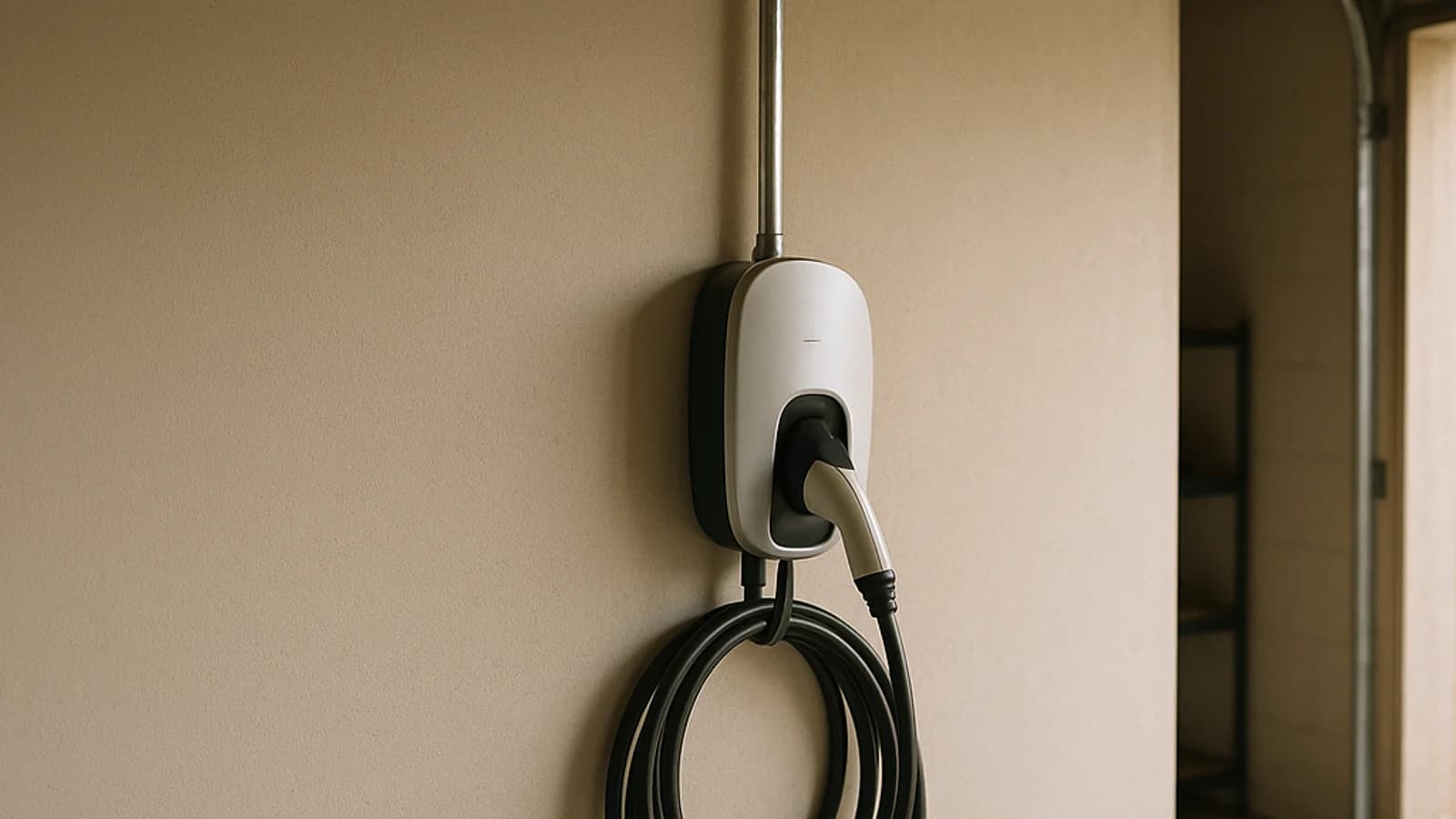
Almost every EV charger quote is really a quote for two things: a short amount of electrical work, and an answer to the question of whether your existing service can carry the load. The first is predictable. The second is where the money is.
The good news for most Chicago-suburb homeowners is that the common case — an attached garage, a 200-amp panel, a run of twenty to fifty feet — is genuinely affordable and takes half a day.
| Scope of work | Typical range | What moves the price |
|---|---|---|
| Charger on the wall shared with the panelBest case. Short conduit run, minimal labour. | $700 – $1,100 | Best case. Short conduit run, minimal labour. |
| Typical attached garage, 20–50 ft runThe most common scenario in Fox Valley subdivisions. | $1,100 – $1,800 | The most common scenario in Fox Valley subdivisions. |
| Detached garage with trenched feeder and sub-panelTrenching dominates. Ground conditions decide the number. | $2,500 – $6,000 | Trenching dominates. Ground conditions decide the number. |
| NEMA 14-50 receptacle instead of a hardwired unitNeeds GFCI protection under NEC 625.54, which narrows the saving. | $600 – $1,300 | Needs GFCI protection under NEC 625.54, which narrows the saving. |
| Load management device to avoid a panel upgradeFrequently cheaper than upgrading the service. Price both. | $400 – $900 added | Frequently cheaper than upgrading the service. Price both. |
| Panel upgrade where capacity is genuinely shortThe single largest variable in an EV quote. | +$2,200 – $4,800 | The single largest variable in an EV quote. |
Ranges reflect typical Chicago-area pricing and are for planning only — they are not a quote. Actual cost depends on your home, your existing wiring, and the permit requirements in your municipality. Only a licensed electrician who has seen the job can price it.
The 125 per cent rule, and why cheap installs get it wrong
NEC 625.41 requires the circuit feeding an EV charger to be sized at 125 per cent of the charger's continuous output. A 48-amp charger therefore needs a 60-amp circuit, not a 50-amp one. This is the most common corner cut on a budget installation, and it is not a paperwork technicality — the circuit is carrying its full rated load continuously for hours at a time, which is exactly the condition undersized conductors fail under.
It is also the reason a quote should tell you the wire gauge. Running 6 AWG where 4 AWG is required saves the installer perhaps sixty dollars and leaves you with a circuit that has to be redone before you can ever move to a faster charger.
You may not need a panel upgrade at all
The default assumption — old panel means panel upgrade first — is often wrong, and it is worth pushing back on. Where the service is genuinely short of capacity, an energy management system under NEC Article 750 can throttle or pause charging when the rest of the house is drawing heavily. Since a car sitting in a garage overnight does not care whether it charges between midnight and 4am or 2am and 6am, the practical impact is usually zero.
At $400 to $900 added, that is frequently half the cost of a service upgrade. It is not always the right answer — if the panel is obsolete or full for other reasons, upgrade it — but any electrician who has not mentioned the option has not given you the full picture.
Hardwired or plug-in
A NEMA 14-50 receptacle looks cheaper on paper, and at 32 amps or below it often is. At 40 amps and above the maths shifts, because current code requires GFCI protection on receptacle-fed EV connections and that protection costs real money. Hardwiring avoids the requirement and removes a connection point that heats and loosens over time.
Plug-in also has a practical failure mode people underestimate: a 14-50 receptacle rated for occasional RV use is not built for a 40-amp draw eight hours a night, every night. Cheap receptacles on EV duty are a recurring source of scorched outlets.
Keep the permit — it is often worth more than it costs
A new 240-volt branch circuit requires a permit and inspection everywhere in the Chicago metro. Beyond compliance, utility and manufacturer rebate programs consistently require proof of a permitted, inspected installation by a licensed electrician along with itemised invoices. Program terms change often enough that it is worth confirming what is currently open before you buy, but the paperwork requirement is a constant.
Skipping the permit to save $150 and forfeiting a rebate worth several hundred is a bad trade that homeowners make regularly.
EV Charger Installation in your town
Local permit authority, electric utility, and the housing eras that decide what your house actually needs.
All towns for ev chargers